Your World of Text: Difference between revisions
| Line 293: | Line 293: | ||
* As stated in an interview with Andrew Badr, YWOT is believed to be the oldest infinite canvas on the internet.<ref>https://cultorjustweird.libsyn.com/s2e7-the-line</ref> | * As stated in an interview with Andrew Badr, YWOT is believed to be the oldest infinite canvas on the internet.<ref>https://cultorjustweird.libsyn.com/s2e7-the-line</ref> | ||
* Instead of a chat, YWOT used to have an active IRC featuring all the most active members of its community. Today, [[Sammich|Sammich's]] Wokecat is believed to be the successor of the IRC, and is still frequented by many of YWOT's old guards. | * Instead of a chat, YWOT used to have an active IRC featuring all the most active members of its community. Today, [[Sammich|Sammich's]] Wokecat is believed to be the successor of the IRC, and is still frequented by many of YWOT's old guards. | ||
* A [https://www.startribune.com/miranda-july-s-bright-future/127312863 ''Star Tribune'' article] from 2012 mistakenly attributed the creation of YWOT to popular writer/artist [[wikipedia:Miranda_July|Miranda July]]. | |||
* YWOT was featured in [https://elmcip.net/creative-work/your-world-text a digital poetry class from 2010] along with [https://stars.library.ucf.edu/elo2020/live/events/11/ an online social experiment from 2020], and was even used as someone's [https://www.yourworldoftext.com/~maritas college thesis] in 2024(''though it didn't seem to get anywhere''). It was also mentioned in a number of academic papers<ref>https://scholar.google.com/scholar?hl=en&as_sdt=0%2C5&q=yourworldoftext&oq=yourwor</ref><ref>https://www.sens-public.org/articles/1699/</ref>; the 2013 paper titled "''Quotationalism in Digital Literature''" had the following to say about the infinite text canvas: | * YWOT was featured in [https://elmcip.net/creative-work/your-world-text a digital poetry class from 2010] along with [https://stars.library.ucf.edu/elo2020/live/events/11/ an online social experiment from 2020], and was even used as someone's [https://www.yourworldoftext.com/~maritas college thesis] in 2024(''though it didn't seem to get anywhere''). It was also mentioned in a number of academic papers<ref>https://scholar.google.com/scholar?hl=en&as_sdt=0%2C5&q=yourworldoftext&oq=yourwor</ref><ref>https://www.sens-public.org/articles/1699/</ref>; the 2013 paper titled "''Quotationalism in Digital Literature''" had the following to say about the infinite text canvas: | ||
<blockquote>"''The idea of the embodiment and realization of the open, interactive and fleeting text played a major role (especially for authors) in digital literature in the late 1990s and early 2000s. While some claimed the impossibility of open text, others (most) turned to implementing this idea, without any irony. One of the works that tries to implement open text is the website yourworldoftext, which designs a blank sheet that can be written on in all directions:'' 'Your World of Text is an infinite grid of text editable by any visitor. The changes made by other people appear on your screen as they happen.' T''he freedom that the endless page promises is clouded by the fact that the flow of writing still runs from left to right and therefore linearly. Furthermore, the fact that every visitor can write something on the page creates pubescent textual struggles and removes this text, at least temporarily, from the field of literature. Some note-taking projects attempt to create an ever-growing, rhizomatic web of text. This is what an entry on the association blaster platform, which has been growing since 1999 and is probably the most popular, says:'' 'This network is, proceeds as and builds a rhizome!' ''The authors Alvar Freude and Dragan Espenschied announced their work in 1999 as'' 'a new way of organizing information.' 'an encapsulated prototype of how the web could work: from the bottom up' ''and'' 'a connection between all kinds of views, languages, cultures and people that creates the ultimate, post-modern ambivalence - or a kind of in-between fact- Knowledge.' [...]" | <blockquote>"''The idea of the embodiment and realization of the open, interactive and fleeting text played a major role (especially for authors) in digital literature in the late 1990s and early 2000s. While some claimed the impossibility of open text, others (most) turned to implementing this idea, without any irony. One of the works that tries to implement open text is the website yourworldoftext, which designs a blank sheet that can be written on in all directions:'' 'Your World of Text is an infinite grid of text editable by any visitor. The changes made by other people appear on your screen as they happen.' T''he freedom that the endless page promises is clouded by the fact that the flow of writing still runs from left to right and therefore linearly. Furthermore, the fact that every visitor can write something on the page creates pubescent textual struggles and removes this text, at least temporarily, from the field of literature. Some note-taking projects attempt to create an ever-growing, rhizomatic web of text. This is what an entry on the association blaster platform, which has been growing since 1999 and is probably the most popular, says:'' 'This network is, proceeds as and builds a rhizome!' ''The authors Alvar Freude and Dragan Espenschied announced their work in 1999 as'' 'a new way of organizing information.' 'an encapsulated prototype of how the web could work: from the bottom up' ''and'' 'a connection between all kinds of views, languages, cultures and people that creates the ultimate, post-modern ambivalence - or a kind of in-between fact- Knowledge.' [...]" | ||
Revision as of 16:54, 12 October 2025
 | |
 YWOT in 2023 | |
| Created by | Andrew Badr |
|---|---|
| URL | https://yourworldoftext.com |
| Launched | August 5, 2009 |
*Check out the YWOT Wiki!
*Also check out the YWOT Wiki's page on OWOT!
Your World of Text (YWOT) is an infinite text canvas created by Andrew Badr. It is the predecessor to Our World of Text, and also the site where most users discovered OWOT.
Our World of Text began as an identical copy of YWOT without rate limits, which Andrew created as a playground for scripters.[1] OWOT was later rebooted in 2017 by members of the YWOT community.
As an older website, YWOT lacks many features such as colors, teleportation, and a built in chat. The absence of teleportation is especially important in that it forces users to explore the canvas manually. The end result is a sprawling open world filled with content, most notably along highways that spawn entire communities with their own cultures and landmarks.
Scripting, on the other hand, is commonly seen exclusively for its applications in spamming. The existence of a higher rate limit also restricts the range of scripted creations(though a number of interesting scripts have historically existed).
YWOT nowadays barely functions. Changes made to the site since 2015 have rendered most scripts defunct, and the server in its current state can no longer handle large amounts of users without lagging. The last major update from Andrew Badr was in 2021 when he changed the site from html rendering to canvas rendering.
The site is currently in its most dormant era yet, though the upside to this is that new users get to explore 10+ years of content in a state of relative peace.
YWOT has a Discord server just like OWOT, though it was never particularly active.
Features

*See also /Mainpage
Though it lacks in many of OWOT's features, YWOT makes up for it by being a massive open world filled with 10+ years of contentas of 2025.
Users are encouraged to scroll in any cardinal direction, where they can follow one of the site's many roads/lines to a variety of distant landmarks. They may also choose to explore randomly; either way they'll find no shortage of messages and (mostly) hand-made creations.
The YWOT Mainpage has been wiped multiple times throughout its history, with the last reset happening in July 2015 in response to a massive wave of spam.
The website itself, meanwhile, has been around for 16+ years. A great host of content from before the 2015 Wipe can still be found in the site's numerous subworlds, or within one of the many Mainpage archives created by Andrew Badr(the two archives linked here are all covered by spam within a radius around Spawn, but give way to hand-made content as you scroll out).

Interactions With OWOT
Historically, there have been measures that "merged" the two websites to some capacity, either by enabling OWOT features on YWOT or directly syncing edits between the two canvases. Most of the time these interactions contribute to heavier spam on YWOT.
Warpserver
/warpserver was a chat command that allowed users to access other websites from the OWOT client. FP created it for users to connect to their custom instances of OWOT, but instead it was used to copy/paste, teleport and run OWOT scripts on YWOT(though colored text was not supported).
The /warpserver command was removed by FP for being problematic in multiple ways. Not only was it used to spam YWOT, but Warpserver also posed a security risk, with the possibility of it teleporting users to IP grabbers or other harmful sites.
To this day there are still ways to access YWOT from the OWOT client, though this can no longer be accomplished using "official" means.
Fastclient
The Fastclient was a website, formerly hosted at 2s4.me/public/ywot/fastclient_v1_jul_25_2021.html, that presumably functioned in a similar way to the Warpserver. It allowed users to access multiple OWOT features on YWOT—such as copying/pasting, faster scrolling, and wider zoom—but teleportation was not supported.
The Fastclient was discreetly disseminated within the YWOT community throughout 2021 and 2022. Notably, it gave users the ability to back up their art and take larger screenshots. And while teleporting wasn't enabled, the scrolling speed at max zoom was fast enough that you could reach 10,000 coordinates in under a minute, so many used it as a way to fast travel to distant art projects.
But critically the Fastclient was also used to spam, and it was for this reason that FP eventually took down the website. AndreiXYZ stated on the Discord that the Fastclient was never supposed to be found by the public, though for unknown reasons it ended up being listed on DuckDuckGo.
OWOT-YWOT Bridge
*See also: OWOT-YWOT_Bridge.
In August of 2024, Catha'vi(then Moth Cult Leader) launched a script that synced edits between the two sites within a small portal. They later created another bridge that allowed YWOT users to interact with OWOT's Global Chat.
Unlike the Warpserver and Fastclient, which were used to spam YWOT without the community's knowledge, Catha'vi's OWOT-YWOT bridge was able to create an open, two-way interaction between the two text canvases. Reception to the portals were generally positive on both websites, though there was some backlash from the YWOT community over the insertion of OWOT chat into YWOT.
The creation of the OWOT-YWOT Bridge was commemorated by Lemuria in the September 7th Issue of Our World of News. FP also complimented Catha'vi for their creation, citing it as an improvement over their previous script: the roomba. Mr.Guy commented on the bridge and compared it to the New York-Dublin Portal.
-
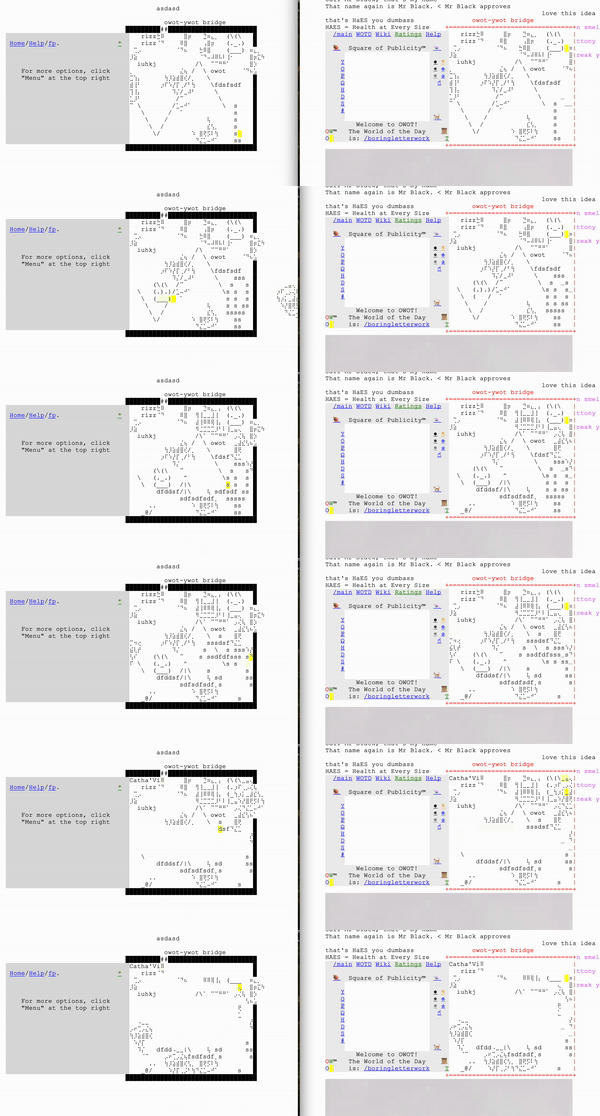 The first bridge(sped up 20x)
 -
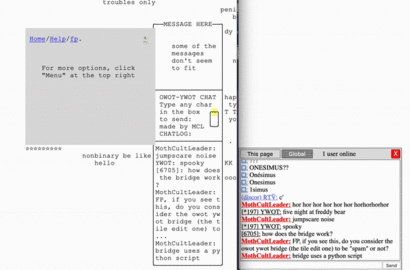 The second bridge(real time)


Cross-Site Racism
OWOTers on YWOT
"I visited YWOT only like once and it felt like OWOT if 99% of it were anons and there was no color in it. It feels soulless."
Due to YWOT's lack of features, many OWOT users see it as a more handicapped site.
Lack of support for colored text and Symbols for Legacy Computing(among many other things) greatly decreases the scope of art that can be created. Stricter rate-limits on YWOT also serve to restrict scripting, which is considered to be a major source of creativity in OWOT.
There is also the fact that YWOT simply isn't very well optimized in the current day, and would lag unbearably whenever too many users are online. Indeed, Andrew Badr has largely abandoned his site in the current day, whereas FP still maintains OWOT on a regular basis.
OWOT users have noticed, in addition, that scrolling is much slower on YWOT, making for a jankier experience. One user reacted with disgust at the inclusion of scrolling momentum, where the screen would keep on moving for a brief moment after you stop scrolling. Ironically, another user from YWOT once criticized OWOT for not having momentum.
It should be noted that clicking and dragging is the default method of travel for most YWOT users, though this is still slower than scrolling on OWOT, and is also much more uncomfortable to do over an extended period of time.
Many have also reported that they simply missed the presence of colors, and felt that the experience wasn't the same in black and white.
YWOTers on OWOT
"Sounds accurate, OWOT is just a really toxic place with people stuck inside spawn.
Mostly because they have no motive to move around, all the tools are readily available to see monuments.
And that horrendous chat box..."
Our World of Text is seen by much of the Your World of Text community as a more toxic version of YWOT where spamming is more prevalent. The script-centric nature of OWOT also lends it a bad name, since most YWOT users associate scripting exclusively with spam.
The chaotic nature of OWOT's canvas reinforces this stigma for many YWOTers visiting their sister site for the first time. More often than not, users would enter the canvas only to be greeted with torrents of spam at a scale far surpassing what is normal for YWOT. Features like text colors and SLC only make this more of an eyesore, as they enable spammers to paste high resolution images that are frequently NSFW in nature. Likewise, original content such as art and conversations are much harder to find, usually being limited to select (often ephemeral) islands of safety.
That being said, most YWOTers have not been on OWOT long enough to learn of its more artistic qualities; or that scripts can be used for the site's benefit rather than just for spam. Though it should be noted that in many areas, OWOT does in fact attract a more reprehensible userbase than its predecessor, with the global chat in particular being a cesspool of toxicity. A lot of this may have to do with the fact that OWOT users are generally younger than their YWOT counterparts.
This is not to say that YWOT is without toxicity, however, though most of it does seem to have subsided in the current day. And any crimes committed by past users would have been lost to time, whereas OWOT keeps a better record of its misbehaving members.
Another source of animosity comes from the fact that much of YWOT's appeal comes from exploration, where generations of users follow each other on lengthy pilgrimages, reacting to older text all while leaving messages of their own to encourage future travelers. The lack of teleportation also means that the vast majority of spam/toxicity is confined to Spawn, an area that can easily be left behind to explore a more pleasant environment.
Easy access to teleportation removes any incentive for manual exploration in OWOT, meaning that there really isn't much to find after you scroll past the chaos of Spam Central. It is for this reason that many YWOT users see their sister website as a more hollow experience.

The Takeaway
The general consensus among those who have spent time in both websites is that YWOT and OWOT simply fulfill different niches. While YWOT is considered to be an open world text processor[2] with a focus on manual exploration, OWOT is seen by most of its userbase as sandbox centered around experimentation(Ex. with art and scripting). FP has also noted that whereas YWOT users find meaningful content by exploring the canvas, users in OWOT do so by visiting other worlds, many of which are unique experiences in of themselves.
Still, most users of the two WOTs believe their site to be superior and argue about it time from time; the dynamics of these discourses being biased towards whichever Discord server the argument is happening in.
Concessions made within the OWOT Discord have stated that while OWOT is objectively the better site, YWOT arguably has a better community. This did not prove to be a satisfactory compromise and further conflict ensued.
-
 Argument about the two sites in the YWOT Discord
 -
 Argument about the two sites in the OWOT Discord


The majority of OWOT users found the site through YWOT.
In turn, most of them found YWOT from an 2011 Vsauce video, which to this day remains the biggest source of new users to all three of the World of [x] sites.
OWOT itself began as a spin-off of YWOT by the site's creator, and the 2017 reboot of the site was founded by veterans of the YWOT community.
However, very few users can be said to have been fully active in both sites. The more notable among them have been listed below.
InfraRaven
InfraRaven, the admin responsible for hosting OWOT and OWOP, was one of the most influential users in the history of YWOT. He was active since 2011 and had the closest ties with Andrew Badr out of any known user. In 2021 it was he who convinced Andrew to reopen the Mainpage, after it had been locked down to prevent racism spam.
InfraRaven has worked on a number of projects throughout his long history on the site. In 2013, for instance, he contributed to an in-site YWOT Wiki and that same year he created the soundtrack for a YWOT snake game named Grubber. InfraRaven was also known to have fought numerous spammers, including the DeathCloud faction and the infamous Lol("Hitler")007, who spammed userpages using scripts stolen from InfraRaven hiimself.[3]
InfraRaven, along with other veterans like JerryStarField, Dzeni, Anon_guy, Sammich, Mr.Guy, Kkb and Poopman, made up the "inner circle" of YWOT during the early 2010s. At one point they even created a hidden society named YWOTI(YWOT Illuminati) that operated on a private subworld.
When Andrew Badr shut down the original OWOT in 2015, InfraRaven was given ownership over the "ourworldoftext.com" domain in case he ever wanted to revive the site. A loose effort to remake OWOT ran from 2016 to 2017, though it ultimately ended up failing. But in 2017 he discovered FP's OWOT clone "NodeWorldOfText" and decided to host it under the OWOT domain.[4]
FP
FP came to the site slightly later than most of the other admins, around 2015. But since then he has gained a reputation for archiving the site's Mainpage. At one point Andrew noticed his work enough to link his world on YWOT's Center Console
The base world /~fp/ has recorded changes made to YWOT's Center Console ever since 2015; it served a similar role to OWOT archive pages like AndreiXYZ's /center_console_history and /mch_complete. The world /~fp/photographWorlds was later created to host several large Mainpage snapshots, while a collection of smaller snapshots can be found at /~fp/waybackYWOT.
Though he does not have admin permits, FP is the closest thing YWOT has to an active moderator now that Andrew Badr is dormant. In 2022 he restored YWOT's Mainpage after two large scaled griefs that destroyed hundreds of coordinates of text. When asked, FP reassured that he had a backup of the entire Mainpage from 2020. He also filed a report to Cloudflare after YWOT was falsely flagged for phishing at the beginning of 2025.
FP began working on an YWOT clone named NodeWorldOfText in mid-2016. In 2017 the project was noticed by InfraRaven, who offered to host it under the "ourworldoftext.com" domain. The name "NodeWorldOfText" was later given to the open-source version of OWOT.[4]
Mr.Guy

Mr.Guy is a scripter and former spammer who briefly worked for Andrew Badr in 2015. He was tasked with removing emojis from YWOT, since they had a habit of messing with the formatting. And though Andrew ended up removing emojis himself, Mr.Guy still appreciated the opportunity to work on the text canvas.
As a reward, Mr.Guy was paid in a sum of Bitcoin that now has him "tossing and turning at night."
On the YWOT canvas, Mr.Guy started off as a spammer but eventually turned his focus towards more helpful endeavors like road maintenance. He was most famous for building the North Road ladder, one of the first major Northern trails from after the 2015 Wipe.
He left YWOT for OWOT due to the former site's negative sentiment against scripting. Today he is one of the more active admins other than Fern or FP(active as in leaving messages, not performing administrative actions).
Mr.Guy has said that spamming in YWOT was one of the things that got him into scripting in the first place.
Most of the Admins
Along with InfraRaven, users like JerryStarField, Dzeni, Anon_guy, Sammich, Mr.Guy, Kkb and Poopman were all active in the early 2010s era of YWOT. Most of them found the site from VSauce.
From 2016 to 2017 a good number of the above users were involved in an attempted remake of OWOT, whose betas can be found here.
Dzeni and Anon_guy were some of the first users to learn of FP's NodeWorldOfText and offered to host it on their server.[4] When NWOT was released as the modern OWOT, they and much of the YWOT "inner circle" joined the new website as admins. Over the years most of them have been inactive, however, prompting much talk of nepotism among the userbase. This culminated in 2024 when AndreiXYZ led an effort to install Fern as the first new admin on the OWOT Discord.
In the early 2010s, the OWOT admins were primarily known on YWOT for the following:
- Dzeni: Leader of the Anti Spam Group, a controversial faction that distributed erase scripts for users to clean spam in both the Mainpage and YWOT's many subworlds. The ASG functioned in the most spam-heavy period in the site's history.
- Sammich: Created a script that pasted the message "sammich was here" on every subworld with fewer than five letters in its name.
- Mr.Guy made a similar script that pasted the message "mr.guy was here."
- Poopman: Created several games that were fully playable within YWOT. He also collaborated with a user named Codefactor to create Space Fighters, which was later remade in OWOT.
- These games, along with most scripts from the time, were made defunct when Andrew rewrote the site's client.
Kkb


Kkb is a renowned ASCII artist on both websites, having created high quality PETSCII/ASCII art since 2012. He has been a gold standard for countless artists to aspire to.
Most of the drawings on his world were in fact copied over from YWOT.
He hosted co-op worlds on both sites(/~kkb/coop on YWOT and /kkb/coop on OWOT) where artists could collaborate, though both of these pages have been made private as of 2024.
-
 A city created by kkb in an old YWOT subworld from 2013

DIGIBILLCIPHER
DIGIBILLCIPHER was a veteran user who had a presence on both YWOT and OWOT during the late 2010s, around the time when modern OWOT was first founded. She is a part of the United Snowy Boys faction along with other veteran users like Poopman and Sammich.
AndreiXYZ
Andrei was active on the YWOT Discord from 2021 to 2023, during which he feuded with a user named Jesse78 over emoji spam. For context, Jesse had been reacting to every message with the :bike: emote.
Andrei's main criticism was that the server had devolved into meaningless faction wars with there being very little discussion about the site itself.
It must be noted, however, that Andrei had previously cooperated with Jesse over his effort to react to every message with the :nobikes: emote. It is possible that he only turned on Jesse after he switched to being a bike enthusiast.
Andrei became mostly inactive after the emoji spam died down.
In addition to this, Andrei had also put in a good amount of effort to study the history of YWOT, especially as it relates to OWOT.


MCL/Catha'vi
*See MCL's YWOT Wiki page here.
Catha'vi began their moth-related career on YWOT, at the beginning of 2024. At the time they were a user named Moth Cult Leader(MCL for short).
In their early days MCL spammed ASCII moths around spawn, created an indestructible bill board praising moths, and infamously deployed a moth-themed roomba that was inspired by an older YWOT user named -- The Janitor.
Having grown weary of being called a moth-themed Janitor—and having received no shortage of backlash for the roomba—MCL decided to create a series of original scripts, ranging from an interactive chatroom to a user-controlled toy car. It was around this time(in March 2024) that they joined the OWOT Discord and invented the "Catha'vi" character.
In August of 2024 they linked YWOT and OWOT using a series of OWOT-YWOT bridges, earning them praise in both communities.
The Manhatingzone
*See the YWOT Wiki's page for the MHZ here.
The Manhatingzone faction has existed long before the creation of the current OWOT, supposedly being present at the creation of YWOT in 2009.
/OWOTD/iceberg mentions that the MHZ have feuded with the Mormons of old YWOT and witnessed the spammer vs eraser wars of 2013. Their world, /manhatingzone, was supposedly the most active world in YWOT before it was privated.
The MHZ was said to have largely migrated to OWOT following the 2020 YWOT Lockdown, though they did make a brief return in 2022.
The MHZ on YWOT acted in much the same way they did on OWOT: making ASCII art here and there, getting into feminist arguments here and there, fighting spam here and there all while spewing out an ungodly amount of the most despicable fanfiction imaginable.
Meimei
Highly suspected to be a member of the Manhatingzone.
Meimei appeared on YWOT in 2022, coinciding with a brief MHZ revival, and made a variety of high quality ASCII art under the name "Kiki."
Her YWOT worlds are /~kiki./, /~kiki./archiveand /~kiki./stairway.
InfraRaven once commented that her art reminded him of rcatface, an artist who made drawings on YWOT in the early 2010s. Rcatface used similar techniques as Meimei in mixing traditional ASCII art with unicodes.
Bzuki
Bzuki is known to have traveled to Y:10,000 in YWOT, reaching the fabled citadel of Nirvana.
In 2023 they joined in Andrei and Jesse's emote war, fighting on the side of scooters. He renamed himself to "Scooter Scroller" in the process and has not changed it since.
As of 2025 he is still occasionally active on the YWOT Discord.
Guest-1052
Guest-1052 joined the YWOT Discord server in late 2023 and has since become a semi-active member of the community. His user name on the Discord is "Mr. ~Dickman," and his YWOT world is /~dickman/.
Akatas
Akatas joined the YWOT Discord in April 16th, 2024 and has been occasionally active since.
Lemuria
Lemuria joined the YWOT Discord on the same day as Aka, most likely to gather information for his newspaper(which he advertised to the YWOT userbase, much to their astonishment). The September 14th Issue of OWON documented the creation of the new YWOT Wiki by LiquidVicinity, along with an incident where Rscr discovered (possibly) original ASCII porn from 2009. Lemuria would go on to cover a variety of more innocuous YWOT findings after the inclusion of this latter event sparked backlash from AndreiXYZ.
A nice caveat of being in a new community was that almost all of the negative sentiment against Lemuria were left behind in the OWOT Discord... For a while, at least. Eventually his OWOT drama did spill over, but only briefly. As a whole, YWOTers still admired him for making a high quality newspaper; Our World of News was possibly the first piece of positive exposure for OWOT in the YWOT community.
On another note, Lemuria ended up befriending another Filipino user named Yosicat on the YWOT Discord. The two of them had a brief conversation in Tagalog about various happenings around the Philippines.
Noman/Nomar
Noman, also known as Nomar, is a skilled PETSCII artist from YWOT who also learned how to draw with Symbols for Legacy Computing after migrating to OWOT.
He was part of the YWOT Explorers community, which has so far been the central circle of YWOT in the 2020s.
Chenn
Also a member of the YWOT Explorers.
Chenn was known for his supremacist attitude, and his month-long stay within the OWOT community left him with the impression that the site was nothing more than a toxic cesspool that was inferior to YWOT in every way. He expressed this opinion numerous times within the OWOT Discord.
Mr. Black
*See Mr. Black's YWOT Wiki page here.
Mr. Black was a user who first found YWOT in 2010, but did not become active for over a decade.
In August of 2024 he returned to test a series of animation scripts in YWOT, most notably an ASCII car that slowly moved around the canvas. They later transferred their activities to OWOT after finding out that it has a higher rate limit.
On OWOT, his accomplishments included: animating Bad Apple, running a fully functional version of Pac Man, figuring out a way to livestream his desktop using SLC characters, creating a water simulator, and making a faster car than the one he made on YWOT.
Rscr
Rscr, yet another member of the YWOT Explorers, has been active on YWOT since 2020. He had known about OWOT since around that same time, but did not become active in it until 2024, when scripts like the OWOT-YWOT bridge and Mr. Black's creations showed him the values of the site.
Rscr's activities on both websites include exploring worlds, creating ASCII art, and archiving pieces of history. His notable creations include a Spawn timelapse for YWOT and a series of large stitched snapshots for OWOT. He is active on the wikis and Discord servers for both communities.
Gallery
The many wonders of YWOT, including spam, ASCII art, and traveling down endless roads.
-
 A landmark from the 2015 Archive of the North Road
 -
 A sign in sheet along the modern North Road
 -
 A sign in sheet along the East Road
 -
 North Road travelers talking about the site's history
 -
 A West Road landmark
 -
 Weird bunnies are a staple of YWOT's Spawn
 -
 Spawn Box art by Mr. Black
 -

-
 FIGHT THE GREY!!!
 -
 An archive of Spawn, one day before the Void Incursion
 -
 The Void Incursion that covered Spawn for all of May 2022
 -
 The YWOT Farm, a collaborative art project at spawn
 -
 Despite not supporting colored text, you can technically have color in Your World of Text.
 -
 A dense cluster of handmade messages, no spam in sight
 -
 In 2023, two users managed to replicate the entirety of Getting Over It in YWOT, completely in ASCII form.
 -
 An outdated YWOT iceberg by Rscr


-
 The City of Paradise from the 2010 Archive, it exists at the same spot as the current day Sky City

Trivia
- As stated in an interview with Andrew Badr, YWOT is believed to be the oldest infinite canvas on the internet.[5]
- Instead of a chat, YWOT used to have an active IRC featuring all the most active members of its community. Today, Sammich's Wokecat is believed to be the successor of the IRC, and is still frequented by many of YWOT's old guards.
- A Star Tribune article from 2012 mistakenly attributed the creation of YWOT to popular writer/artist Miranda July.
- YWOT was featured in a digital poetry class from 2010 along with an online social experiment from 2020, and was even used as someone's college thesis in 2024(though it didn't seem to get anywhere). It was also mentioned in a number of academic papers[6][7]; the 2013 paper titled "Quotationalism in Digital Literature" had the following to say about the infinite text canvas:
"The idea of the embodiment and realization of the open, interactive and fleeting text played a major role (especially for authors) in digital literature in the late 1990s and early 2000s. While some claimed the impossibility of open text, others (most) turned to implementing this idea, without any irony. One of the works that tries to implement open text is the website yourworldoftext, which designs a blank sheet that can be written on in all directions: 'Your World of Text is an infinite grid of text editable by any visitor. The changes made by other people appear on your screen as they happen.' The freedom that the endless page promises is clouded by the fact that the flow of writing still runs from left to right and therefore linearly. Furthermore, the fact that every visitor can write something on the page creates pubescent textual struggles and removes this text, at least temporarily, from the field of literature. Some note-taking projects attempt to create an ever-growing, rhizomatic web of text. This is what an entry on the association blaster platform, which has been growing since 1999 and is probably the most popular, says: 'This network is, proceeds as and builds a rhizome!' The authors Alvar Freude and Dragan Espenschied announced their work in 1999 as 'a new way of organizing information.' 'an encapsulated prototype of how the web could work: from the bottom up' and 'a connection between all kinds of views, languages, cultures and people that creates the ultimate, post-modern ambivalence - or a kind of in-between fact- Knowledge.' [...]"
"Badr, Andrew: Your World of Text The writing project Your World of Text consists of an endless writing sheet or an open source program that simulates such a writing surface. On the endless page, every visitor can move in all directions as a reader or writer. Any visitor can change the text, delete text or add text, and all interventions are immediately visible on the screen. The open and democratic structure of this program suggests that the author had in mind a practical implementation of the 'open text.' Since its average visitor is anonymous and minor, the current state of the work is more of a world of spam."
- Barbara Marković, Quotationalism in Digital Literature
References
- ↑ https://x.com/yourworldoftext/status/15743326242
- ↑ https://x.com/Orteil42/status/1293330316204154881
- ↑ https://github.com/ywothistory/ywothistory.github.io/blob/master/_posts/2012-12-30-modernages.markdown
- ↑ 4.0 4.1 4.2 https://ourworldoftext.com/Interview_with_FP
- ↑ https://cultorjustweird.libsyn.com/s2e7-the-line
- ↑ https://scholar.google.com/scholar?hl=en&as_sdt=0%2C5&q=yourworldoftext&oq=yourwor
- ↑ https://www.sens-public.org/articles/1699/